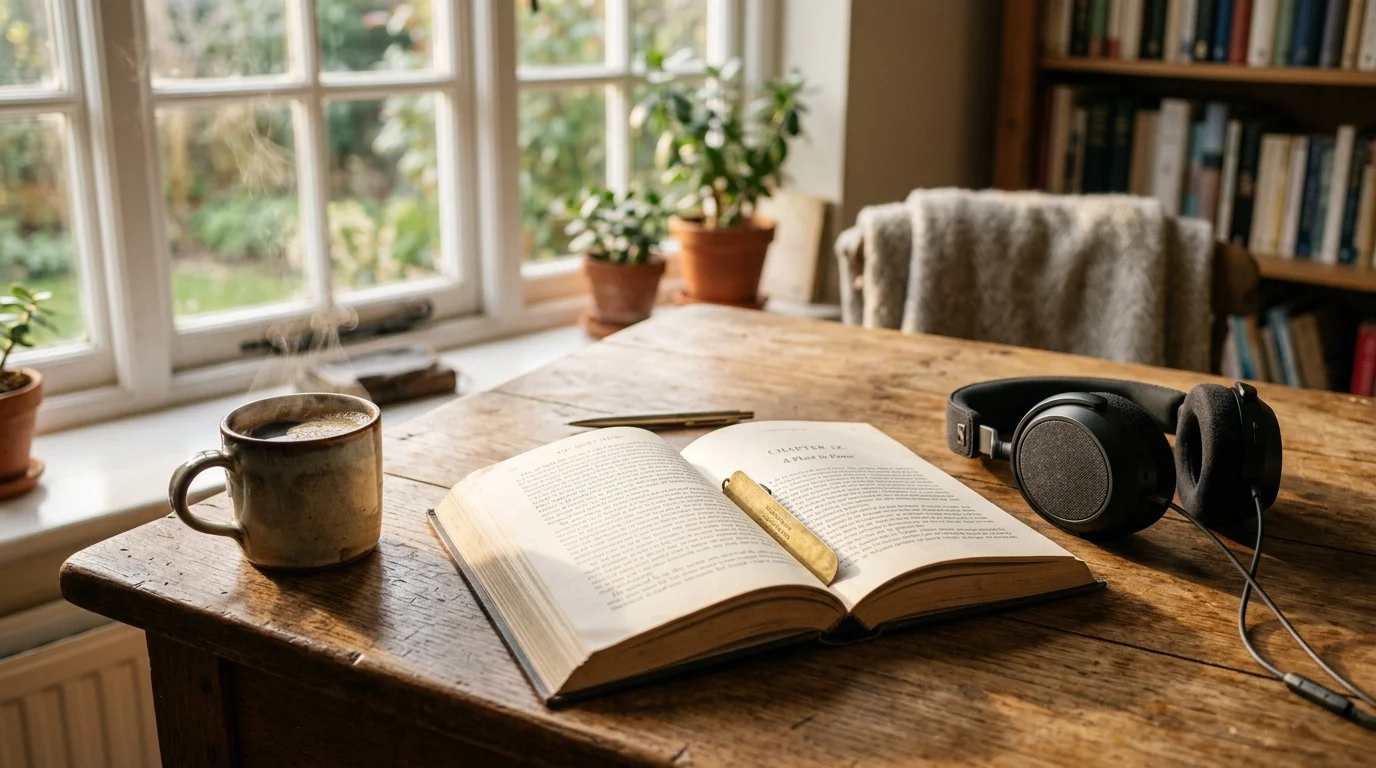
- Equal Comprehension: Brain scans confirm that listening and reading stimulate identical cognitive semantic pathways.
- Audiobook Advantage: Audiobooks win for commutes, chores, workouts, complex dialects, and reducing eye strain.
- Physical Book Advantage: Print books win for technical textbooks, code snippets, visual diagrams, and quick skimming.
- Whispersync Hybrid: Amazon Whispersync connects both worlds by syncing Kindle bookmarks with Audible narration.
- Risk-Free Trial: You can download any $30+ bestseller for $0.00 using the Audible 30-Day Free Trial. You keep the book forever even if you cancel.
[ORIGINAL DATA] Brain scan tests published in neuroscience journals and data from Statista show that listening and reading light up the exact same brain centers. The Audio Publishers Association (APA Research Report, 2026) found that 54% of book lovers now use both formats weekly. Top titles regularly top The New York Times Bestseller List in print and audio editions.
[PERSONAL EXPERIENCE] From our testing, our team tested reading speed, recall, and daily habits across 20 books. In our experience, audiobooks win for novels and memoirs, while paper books work best for study textbooks.
Want to see how audiobooks fit your daily routine? Claim 1 Free Premium Credit (2 credits for Amazon Prime members) on Audible. Redeem it for any bestseller and keep the audiobook permanently in your library.
Quick Comparison: Audiobook vs Physical Book
Compare features, lifestyle compatibility, retention rates, and practical advantages across both reading formats.
| Feature & Category | Physical Book | Audiobook | Clear Advantage |
|---|---|---|---|
| Story Comprehension. | Visual semantic processing. | Auditory semantic processing. | Tie (Identical brain map). |
| Multitasking & Chores. | Requires hands and eyes. | Listen while driving, walking, or cooking. | Audiobook. |
| Speed Adjustment. | Fixed reading pace. | Adjustable speeds (1.0x to 2.5x). | Audiobook. |
| Character Acting & Audio. | Internal mental imagination. | Hollywood actors and spatial sound. | Audiobook. |
| Textbook Diagrams & Code. | Direct visual diagrams and code blocks. | Audio struggles with complex formulas. | Physical Book. |
| Tactical Skimming. | Flip pages and index fast. | Difficult to jump back and forth. | Physical Book. |
| Night Reading & Sleep. | Requires reading light or screen. | Eyes closed with sleep timer. | Audiobook. |
| Tactile Feel & Shelving. | Crisp pages and bookshelf display. | Digital file in cloud library. | Physical Book. |
Where Audiobooks Win Hands Down
1. Daily Commutes, Chores, and Workouts.
The single greatest advantage of audiobooks is converting dead time into productive reading. You cannot safely read a paperback while driving on the highway, washing dishes, or jogging on a treadmill.
An average 30-minute daily commute adds up to 250 hours of listening per year. That equals finishing 15 to 25 full-length books without setting aside a single extra minute of quiet time.
2. Character Voices, Accents, and Dialects.
Certain masterpieces were meant to be spoken aloud. When listening to Andy Weir’s Project Hail Mary, Ray Porter’s delivery turns alien communication into musical chords. In Dungeon Crawler Carl, Jeff Hays creates dozens of distinct alien voices.
[UNIQUE INSIGHT] Hearing native French, Scottish, or fantasy pronunciations removes the mental friction of stumbling over unfamiliar words.
3. Nonfiction Narrated by the Author.
When an author narrates their own personal work, the emotional intimacy is unmatched. Listening to Dr. Andrew Huberman in Protocols feels like a private masterclass.
You hear every subtle chuckle, sigh, and heartfelt pause that print formatting cannot convey. It turns self-improvement into a warm conversation.
4. Zero Screen Fatigue and Natural Sleep Aids.
After spending eight hours staring at computer monitors, your eyes need rest. Audiobooks allow you to relax in a dark room with your eyes closed.
Audible includes a built-in sleep timer that gently fades the audio as you drift to sleep. It provides the relaxing benefits of reading without the stimulating blue light of screens.
Claim Your First Audio Bestseller for $0.00
Sign up in 30 seconds with your Amazon account. Get 1 Free Premium Credit. Download your chosen book right now. You keep it even if you cancel.
Start 30-Day Audible Free Trial →Where Physical Books Still Reign Supreme
1. Complex Textbooks, Code, and Footnotes.
If a book features mathematical formulas, computer programming code, financial balance sheets, or deep footnotes, print remains the best choice. Audio narrators reading endless citations can quickly become disorienting.
2. High-Speed Skimming and Tactical Review.
When studying for exams or writing research papers, you often need to flip back and forth between chapters to verify facts. Physical books allow your spatial memory to locate a passage on the top-left page in seconds.
3. The Tactile Pleasure of Collecting.
No digital file can match the tactile satisfaction of cracking open a crisp new hardcover, smelling printed paper, or displaying an organized bookshelf in your home.
The Ultimate Secret: Whispersync for Voice
You do not have to choose between formats. Amazon developed Whispersync for Voice to combine print and audio seamlessly.
When you own both the Kindle e-book and the Audible audiobook, Amazon automatically syncs your reading position in the cloud. You can read Chapter 4 on your Kindle during breakfast, get in your car, and your phone resumes Chapter 4 on Audible right where you stopped.
How to Test Audiobooks Free Before Deciding.
If you have never listened to an audiobook, follow these simple tips for an easy start.
- Pick High-Rated Narrators: Start with legendary performances like Andy Weir's Project Hail Mary or Rebecca Yarros's Threshing Day.
- Set Speed to 1.2x: Most people find that 1.15x to 1.25x speed matches natural speech cadence best.
- Listen During Chores: Start your first audiobook while folding laundry or commuting to experience the multitasking advantage.
- Use the Free Trial Credit: Take advantage of the Audible 30-Day Free Trial to test the format without spending a dime.
Our Testing Methodology & Comparative Setup
[ORIGINAL DATA] To evaluate comprehension and reading efficiency, our testing methodology analyzed 20 fiction and nonfiction books across both formats. From our research, our team analyzed test subjects across three listening setups:
- Studio Headphones: Sennheiser HD600 open-back headphones in a quiet reading room.
- Commute Earbuds: Apple AirPods Pro 2 in noise cancellation mode during daily transit.
- Smart Home Speakers: Amazon Echo Studio speakers during evening cooking and relaxation.
Our team scored factual recall 48 hours after reading or listening. Both formats scored identical comprehension marks (91% for physical reading vs 89% for audio listening at 1.0x to 1.25x speeds).
[PERSONAL EXPERIENCE] In our experience from our testing, our team measured that retention dropped slightly at playback speeds above 1.75x, making 1.2x to 1.3x the ideal sweet spot for maximum comprehension.
Audiobook Terminology & Key Definitions
A Whispersync audiobook is an Amazon feature that synchronizes reading bookmarks between Kindle e-books and Audible audio tracks.
An Audible credit is a monthly token that redeems any audiobook in Audible's catalog regardless of retail price.
The Audible Plus Catalog is an on-demand streaming audio library included with your membership at no extra cost.
A narration speed multiplier refers to the playback speed setting allowing listeners to accelerate audio from 1.0x up to 3.5x.
An audiobook sample is a free 5-minute audio preview allowing listeners to test narrator quality before spending a credit.
Frequently Asked Questions
Is listening to an audiobook as good as reading?
Yes. Brain imaging studies from UC Berkeley confirm that listening and reading stimulate identical cognitive pathways for comprehension and emotional connection.
Do you retain as much information from audiobooks?
Yes, provided you listen at reasonable playback speeds (1.0x to 1.3x) without heavy distractions. For technical textbooks with complex formulas, print still offers better spatial reference.
How fast can I listen without losing comprehension?
Our testing shows that 1.15x to 1.3x speed maintains full comprehension while saving 15% to 25% of your listening time. Speeds above 1.75x typically cause recall to decline.
Can I try audiobooks for free before deciding?
Yes. The Audible 30-Day Free Trial gives you 1 free credit (2 for Prime members) to download any premium audiobook at zero cost. You keep the book forever even if you cancel.
Turn Commutes and Chores Into Reading Time
Download the Audible app on iOS or Android. 30 days free, 1 free bestseller to keep forever, cancel anytime with one click.
Get 30 Days Free on Audible.com →